Showing posts with label radiometric dating. Show all posts

Polonium Halos

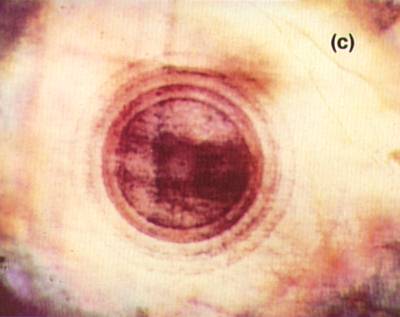
The term “polonium halo” refers to a ring of damaged material where the emitted particles from a piece of radioactive material has basically messed up the surrounding rock. Since the size of the ring is related to the energy of the radiation it should be possible to determine what the radioactive material was that formed a given ring. Gentry looked at polonium halos in granite and concluded that since it takes millions of years for present day decay rates to form a “halo” and because Polonium isotopes have really short half lives (Po218 = 3.05 minutes, Po214 = >200 microseconds, Po210 = 140 days) that this was evidence for an increased rate of radioactive decay.

The problems that strike me are that there’s no mechanism for increased radioactive decay proposed, there’s no mechanism for getting rid of the huge amount of heat that would result from all that radioactive decay happening so quickly, and there’s no mechanism for dealing with the lethal amounts of radiation this would have produced. Finally, there’s a very plausible alternative that avoids all of these problems – Polonium halos are invariably found near uranium halos which makes sense since the isotopes we’re talking about here are all part of the decay series of various isotopes of Uranium.


The immediate precursor in this decay series is Radon, a gas that is quite soluble in water and easily diffuses through small fractures in rock. A steady amount of Uranium decay will produce a steady stream of radon which will steadily decay into polonium which will steadily emit particles as it is formed and quickly decays. I’m no geologist, but that seems like a pretty straigtforward explanation that works a lot better than proposing an unknown decay rate increase mechanism ostensibly offset by some unknown force to remove the huge amounts of heat and radioactivity it would produce.
http://www.csun.edu/~vcgeo005/revised8.htm

When you look at Gentry’s halos you can see numerous rings showing clear sings of Radon and Polonium decay entirely consistent with Radon decaying into Polonium and creating rings along the way.


I’ve seen this argument handled by geologists before, a good discussion of it can be found here:

http://www.evcforum.net/cgi-bin/dm.cgi?action=msg&m=162875

With some particularly pertinent posts on evidence for Radon here:

http://www.evcforum.net/cgi-bin/dm.cgi?act…6261&mpp=15&p=8

Lake Suigetsu - Where no YEC Dares Swim

Every year we can observe algal blooms in Japan’s Lake Suigetsu that subsequently die and sink to the bottom of the lake forming a white layer. If you dig down deep enough into the lake bed you’ll run into thousands of these layers, in fact you’ll run into 100,000+ of them that look like this:


(source)

In these layers we find bits and pieces of organic material one would expect to find at the bottome of a lake which can be dated using carbon-14 dating.  If carbon dating is as error-prone as some claim there’s no reason for us to see any correlation at all, much less a close correlation with counting the number of algal blooms. . .but that’s exactly what we see:

(source)

The radiocarbon dates match up very closely with the varve layers, in other words we reach basically the same dates using two different methods. One of these methods relies on counting annual algal blooms, one relies on radioactive decay. I have never seen any real response to these kinds of correlations, neither have any young earth proponents ever been able to explain why this appears the way it does. And things only go downhill from here, because if we take this data and compare it to samples from around the world the correlations remain consistent.


(source)


Lurker

Radiometric Dating: The Basics

Radiometric dating measures ages based on the amount of radioactive decay that has taken place. There are over forty different techniques of radiometric dating including carbon dating, Potassium-Argon dating, and Argon-Argon dating to name a few.  To understand any of these dating methods you need to understand some of the basic properties of matter.

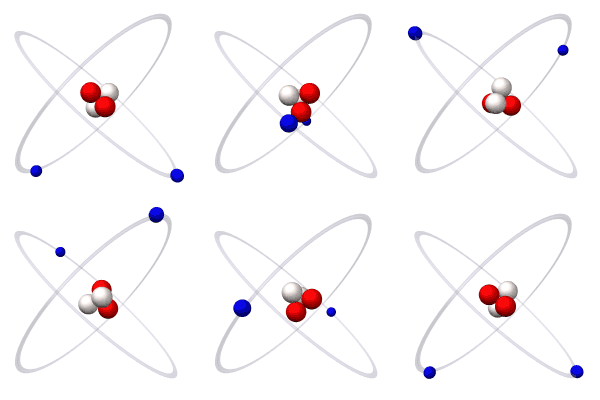
All matter is composed of atoms, which are in turn composed of a nucleus made of positively charged particles (protons) and particles with a neutral charge (neutrons) orbited by a cloud of electrons. Here’s an example:


The number of protons determines what element it is. In our example above there are two protons and two neutrons, so we can flip over to our periodic table and look for an element with an atomic number of 2 (atomic number = number of protons) and in doing so we can see that this is a helium atom.

Each element can have a given number of isotopes, which are atoms that have the same number of protons but a different number of neutrons. As an example, here’s an isotope of helium.


Notice that while the number of neutrons has changed this is still a helium atom because it still has two protons. This will become important later.

Atoms that are radioactive are unstable, so they throw off particles until they reach a more stable state (see Beta Decay Doodle). As the nucleus loses neutrons the atom can become a different isotope, as it loses protons the atom actually becomes a different element. We call this loss of particles “radioactive decay”, the original element is called the “parent”, while the new more stable form is called the “daughter”.

I really can’t stress enough that this is a very simplistic explanation of a very complicated process. If you want to get into exactly how or precisely why atoms and their particles behave this way you start getting into strong and weak nuclear forces and everybody starts to get headaches. That being said, the average decay rate is governed by those forces and, as such, is known. There’s no mechanism we know of that can actually alter these decay rates significantly. . .unless you drop a particularly unstable isotope into the center of, say, a very large star and strip off all it’s electrons. However, the decay rate for every isotope of every atom is unique, which means that if all of this were based on assumptions we wouldn’t expect different radiometric dating methods to reach the same results, which they consistently do.

Additionally, if radiometric dating isn’t reliable we certainly wouldn’t expect for radiometric dates to line up with non-radiometric dates derived from things like tree rings and varves but, again, they consistently do.


Further reading material on radiometric dating:


Lurker

Radiometric Dating, Phantom Variables, & Sock Gnomes

This is taken from an exchange at the end of the longest thread in recorded history on the subject of faith vs. science in which virtually every subject imaginable was covered. We had strayed into radiometric dating, with the thrust of the objections being that the consistent results from multiple independent dating methods (both radiometric and non radiometric) were simply an artifact of the assumptions of scientists.

Beta Decay Doodle